
Much of this piece, and how it lands, is going to depend on whether your organisation considers an EVP to be a cost or an investment. And particularly right now.
It’s hard to describe the current domestic labour market as anything other than challenging. We’ve had weak GDP growth, a lack of political stability, geo-political distractions, all contributing to a general decline in corporate confidence. And this is hardly an overnight development. The number of vacancies in the economy peaked at 1.3m in the quarter March to May 2022. Since then, it has fallen every month without fail to a little over 800,000.
As a result, then, of falling economic confidence and a softer (or more balanced, according to the ONS) labour market, many organisations will have tended to see an EVP more as a cost than an investment over the last three years.
But by attempting to cut costs, by avoiding an EVP revisit, have some employers actually increased those costs? Because an EVP over three years old is going to struggle to maintain its relevance and potential. A great EVP inspires, directs, unites, differentiates, is the source of pride and purpose. But a great EVP is usually not 36 months old.
Given this backdrop, what does your EVP have to do and be this year?
Here are a range of different answers to that question. I’ve also pulled together an analysis table whereby you can do the math on your own EVP. So, here’s a sneak preview. Bear it in mind when you’re reading this.
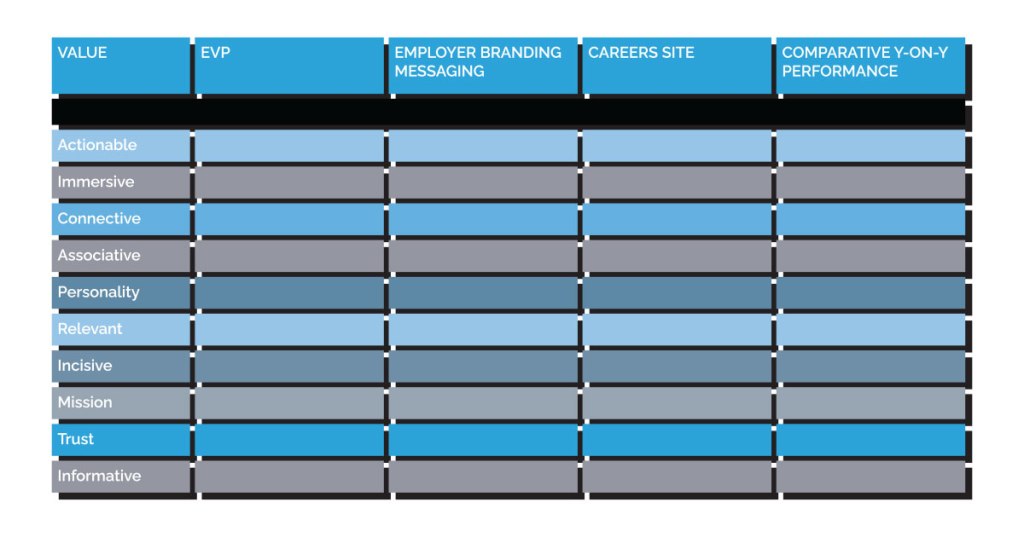
First up?
- Trust.
Employers have to ensure that the promises they are making to existing employees and prospective joiners alike are trusted. The labour market has ground to something of a halt because employers are reluctant to make speedy hiring decisions and candidates are wary about moving jobs. Employers, then, have to make audiences believe in what they are saying about their careers, their trajectory, their future. Your EVP has to reach out and make candidate audiences believe.
What you are saying about your careers has to be credible and believable. Such messaging has to create trust amongst people audiences. Without such trust, there appears little reason to either or continue a professional relationship.
Revisit what you are saying, particularly through the lens of 2025, its challenges and opportunities. Is it credible? Is it believable? It is likely to inspire trust?
- Mission.
An EVP has to communicate a sense of organisational direction, strategy and, most important, how employees can contribute to that sense of mission. Employees and candidates want to understand organisational momentum and trajectory and that their role, their contribution, is playing its part. What they don’t want is to be part of an organisation which appears not to know where it’s going, how it’s getting there and in which employees appear largely incidental.
Clarity around mission also means people messaging gets to share brand equity with the consumer and institutional voice. That your people are crystal clear that what they are doing is not disappearing into the ether, but playing a role in organisational direction, speaks too to internal pride. Make sure there’s a very tangible link between employee contribution and organisational achievement. Your organisation is flying because your people are doing some heavy lifting.
- Immersion.
If there’s one word we tend to over-use within EVP and employer branding, it’s authenticity. It’s not inherently wrong, it’s just become something of a truism. It also feels a little flat, passive and two-dimensional.
Let’s take the idea further. Rather than simply presenting an authentic idea of your organisation’s working reality, go and immerse candidates in it. Create a real experience through your careers site. Bring your working culture to life. Use real imagination through your people and their stories. Real stories – and this is a real bugbear of mine, not 30 second talking heads expressing the grindingly obvious.
Allow your candidate communities to immerse themselves in your working culture. Making a career move shouldn’t be a leap of faith, but a well-informed decision made after real immersion into what working for you is really like. Don’t tell people how authentic you’re being, show them.
- Informative.
Whilst it’s entirely true that an EVP has to capture the imagination, it also has to provide information. Particularly when the economy is challenging, potential candidates are wary and cautious and want as much clarity as possible when changing jobs. Even if they are not entirely enthused by their current employer, their job represents some degree of security. More so than taking a leap into the unknown. They will have a lot of questions about a potential job move – make sure you’ve got the answers.
Better for hiring organisations to turn the unknown into the known. Better to be open, transparent and clear about the careers, opportunities and working reality they are offering. Your audiences need to be able to spot the detail behind the design – particularly at a moment when it’s all too easy to stay put.
- Incisive
Let’s face, there’s a lot of noise all around us. Hiring is a competitor sport. And your EVP and Employer Branding do not exist in a vacuum. And even if the current market means there’s perhaps less competition out there, then all Employer Branding activity represents competition between new employer and existing employer. Should I stay or should I go?
An EVP has to provide an answer to that question. And do so clearly and incisively. We all face a daily barrage of news, noise and messaging. An EVP has to cut through, has to make its point. And quickly. What does it stand for and what is it saying?
And such incisiveness also speaks to confidence. Making a voluntary career move right now requires confidence in a new employer. And the messaging coming out of such an employer needs to convey confidence, ambition and direction. Your messaging has to cut through candidate caution and wariness.
- Relevance
I toyed with the idea of topicality for this point. However, an EVP dating back a couple of years can still be relevant, even if it’s no longer topical.
We’ve seen so many evolving labour market influences over the last few years. We’ve witnessed GDP dropping like a stone in the face of Covid. We’ve then seen it bounce back, along with a resurgent labour market. And we’ve seen two years of anaemic growth and an underperforming jobs market. Your organisation is unlikely to have come through such times unscathed, with its reputation as an employer unmoved.
It’s impractical and devaluing to change an EVP on too regular a basis. But it’s also naïve not to validate it. If both internal and external people audiences feel your messaging is now out of date and lacks relevance, what is this ultimately saying about your business and your grasp of the factors influencing the labour market?
- Associative
In constructing an EVP, it’s hugely important that we understand how both internal and external audiences might process the essence of the EVP and its messaging. There can be a tendency to over-complicate and to become too insular.
Through the EVP process, we need to ensure that both all communities can associate with the employment reality we are projecting. Does the EVP enable them to see themselves working with your organisation? Or has the positioning failed to cut through and engage? The EVP is not designed to persuade everyone they would want to work at your organisation, but they do need to be able to create that mental picture.
They need the clarity to be able to picture what it’s like to work with you and to then make their mind up as to whether they actually want this. Your EVP needs to create that sense of association.
- Personality
We’re dangerously close to the authentic word here. But I think personality goes further and has more richness. The essence of your organisation and its working culture needs to come through in your EVP and its associated employer branding. People joining your organisation shouldn’t be surprised by what they see, hear and feel. All the vast range of communications they have encountered from a candidate through to a new joiner should have carried the personality, the wit, the ambience of your organisation.
Perhaps just as relevant today, most candidates will understand that AI will have played some role in their journey into your organisation, but what they are less enthusiastic about is AI, with its current inability to impart nuance, richness, difference and personality, to articulate that culture. Make sure your employer brand and its personality comes through clearly, consistently and unapologetically.
- Connective
There’s an important point around an EVP, and the communications it inspires, forming connective corporate tissue. There should be clear DNA shared between an organisation’s internal communications, its marketing output and its employer branding messaging. If this isn’t happening, then, at the very least, one of these strands is being diluted and compromised. The reason an individual joins an organisation should share common ground with why that person continues to be inspired by their employer.
Similarly, the EVP needs to be the connection and the common thread that pulls together the various phases of hiring – from interested observer, applicant, candidate, interviewee, offer, new joiner, on-boarding and induction.
And by creating an EVP with clarity, mission and impact, an organisation can enhance cohesion across different sites, different departments, even different countries, through that connective tissue.
- Actionable
There are a number of objectives that prompt employer branding messages. Clearly, organisations wish to hire. They wish to paint an attractive but realistic picture of where they are and where they’re going. Those organisations want cohesion with other elements of corporate communications. They want to carry their values and sense of mission to internal and external audiences alike.
What they want is to create a reaction. They want their employer branding messages to inspire action. That may be applications and interest from relevant candidate audiences – it may, equally, be providing the clarity and information for less relevant candidate audiences not to apply.
Ultimately, an EVP and its messaging should avoid being passive. What does passive messaging suggest about the organisation itself? The messaging should, instead, stir interest, even emotion. It should prompt a response. It should ask questions of its audiences. It should get them to think. Do they see themselves working within this environment, or just the opposite?
Think about your own employer branding messaging – what is it asking of candidate audiences? How are they responding?
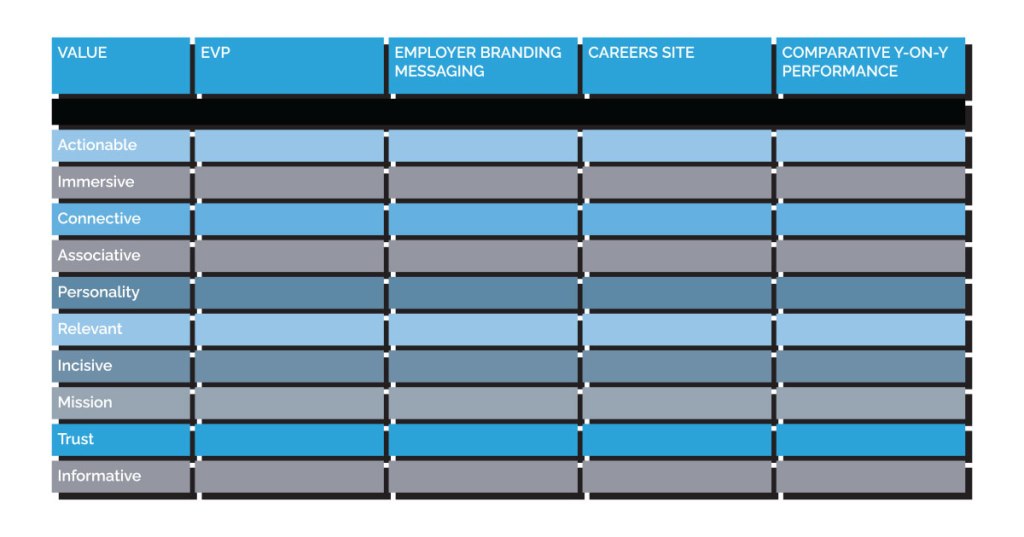
I think ten is about sufficient. You might have some other values your people messaging might want to consider. All good. In a sense, there’s as much to gain from analysing how your EVP is currently performing, than agreeing on the specific parameters. Here’s the table again, I hope it’s of use. And if you want some external input around such evaluation, just let me know.
 Getting to the heart of your employee mindset