The response to Covid-19 is at a fascinating point. Lockdown is easing gradually but perceptibly. Businesses are starting to open and today marks a significant landmark in that process. It’s also not unlikely that we may see the number of positive tests, hospital admissions and coronavirus deaths increase once more.
But how has the talent acquisition community and their employers responded to lockdown and how do they feel about some of the likely outcomes? Without giving too much away, there was relatively little pessimism from those people who kindly responded to my recent survey.
Just short of a hundred people took the survey so there’s an element of this being indicative rather than definitive. But I’m hoping it provides an accurate sense of the mindset of organisations.
Once again, I’ve asked a number of people within my resourcing network to provide their own perspective on the findings. I am hugely indebted on this occasion to Mike Heal, MD at WDAD, Julie Griggs, Consultant at Greenhill HR and Talent, Julian Ward, Group Head of Talent Attraction, Stickyeyes, Craig Morgans, Global Head of Talent Acquisition, IWG plc, and Rob Farace, Head of Recruitment and Progression, Imperial College.
Firstly, who completed the survey?
Respondents were divided reasonably evenly between those working for a multinational, those working across a number of UK sites and those operating out of just one UK location. The majority of them worked for sizeable organisations employing more than 1,000 people, but over 15% had less than 200 people on the payroll.
(There is the possibility that people completing such a survey are perhaps more engaged with this subject area than others within the profession and liable to provide more positive answers).
The survey began by asking talent acquisition professionals about their approach to employee communications during lockdown. The results suggest that this has been a key priority.
We have kept in touch with our people either working from home or furloughed
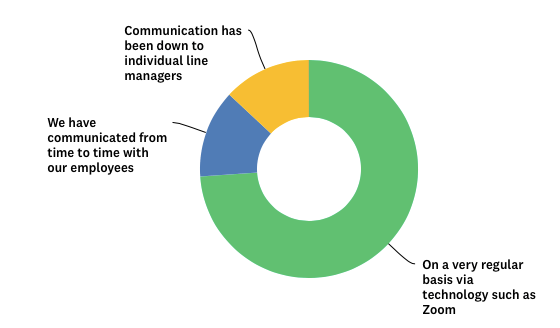
Much use has been made of video conference technology such as Zoom, Google Meet, Skype, bi-weekly town halls, Covid-19 daily briefing notes, Yammer and intranets. There were three more negative options offered to respondents – literally no one opted for these. The importance of communicating regularly to employee bases was made very clear.
“Leaders are having to adapt their approach to work in a virtual world to ensure meetings are inclusive, engaging and productive for all involved in way that is very different to a physical face-to-face event”.
Rob Farace, Head of Recruitment and Progression, Imperial College.
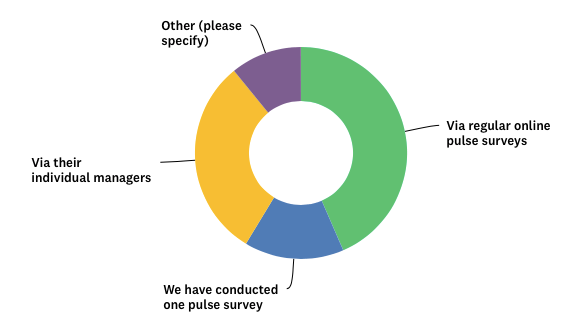
If employers appear robustly keen on communicating outwards to their people, we then analysed how they were going about listening to their employees and their concerns. Perhaps the answers to this particular question feel less convincing, less accountable. If some 43% of respondents were running regular pulse surveys, others seemed to be doing far less. The comments section suggested that a small number of organisations had not run any listening exercises at all.
As we can see through the graph, a number of employers were relying on individual line managers to get a topical view of the hearts and minds of their people. Whilst this probably has value, it will be of variable quality and is unlikely to create much in the way of trackable metrics.
“Pulse tests can be a valuable tool for understanding employees and their concerns, but they must be tailored to the reflect the current situation. The landscape has shifted and the questions we ask our teams need to reflect those changes”.
Julian Ward, Group Head of Talent Attraction, Stickyeyes,
We have been listening to our people and their issues during lockdown
The survey then extended this question, asking respondents if and how communication with their people had changed since lockdown. For some 90% of our respondents, the answer was a greater use of video conference technology to reach out to their people.
The comments section, however, threw up two interesting points.
Firstly, that employees process communication in different ways and styles and that whilst there was a huge uptick in the amount of video conferencing, that the basic tenet of such reaching out was ‘talk more and more often’.
Perhaps less positive was the view that such communications included those people working from home but not those furloughed. Communications for the latter category appeared to dwindle out nearly entirely. The view, apparently, that because they are not allowed to work, they can’t listen in to company communications. We can only guess how excluded such individuals currently feel.
“This crisis has affected organisations at different levels of maturity with regard to communications. Some have always been great, others are on a steep learning curve. What’s clear, though, is that going forward a lack internal comms strategy and disparate messaging can’t be the norm”.
Julie Griggs, Consultant, Greenhill HR and Talent.
But in listening to an employee base, what were the key concerns of the workforce?
Given that no-one has confronted anything vaguely approaching Covid-19 before, people seek answers. This is challenging for organisations, because although the questions feel entirely reasonable, answering them presents an entirely different challenge. If organisations are unable, understandably so, to provide anything resembling a roadmap for the next few months, it is about being open and honest about this situation. About delivering empathetic rationales, rather than empty answers. About suggesting that many of these answers lay in the efforts, commitment and contribution of the people asking those questions themselves.
The key questions that our people want clarity around are:

But it is very clear that an awful lot of employees lack both clarity and security. They have far more questions than answers. It is so important that senior leadership communicates with this in mind.
“Listening has never been more important. Giving people the opportunity to share their thoughts, fears and aspirations and to help shape future plans can combat some of the sense of powerlessness than many will be experiencing whilst being distanced from the workplace”.
Julie Griggs.
It does appear that the vast majority of people at the top of their organisation have risen to the occasion during the crisis. We asked our respondents the extent to which they felt their leaders had remained visible during lockdown. Some 90% of all responses either agreed or completely agreed with this view.
To what extent do you agree with the following statement – Our senior leaders have stayed visible during lockdown

Our questions then moved onto the key question of working from home. Are employees keen to continue operating from their home base or have they missed the company and conversation of their colleagues?
I won’t linger too much on these particular answers as I feel they have been aired with some regularity elsewhere. There does appear something of a paradox, however, in that 74% of organisations are planning on substantially increasing the amount of people able to work from home within their employee base. At the same time, interestingly, 57% agreed with a statement suggesting that a lot of their people would prefer to return to the workplace rather than remain working from home. Personal circumstances, job roles and a desire to collaborate more will all be telling factors in such decision making.
“Employers have to grasp quickly that people’s work patterns will and must change to ensure they remain healthy as well as productive. This doesn’t mean your team are on call 24/7, and should start answering emails at 9:00am, etc, but that they are effective and deliver to agreed timescales whilst using their own working pattern”.
Rob Farace.
Clearly, the workplace will look nothing like it did in late February/early March. 82% of respondents suggested that their organisation will be introducing social distancing protocols into the workplace ahead of any mass return. The time we have all taken for granted sharing stories about families, sports, holidays, nonsense and the formal and not-so-formal conversations about projects, approaches, client situations, they will all have to be approached differently and distantly.
People will doubtless adapt but we might also question whether many of the reasons we enjoy the company and collectivity of the workplace will actually exist in the future. Will we be walking into a working reality where distance and wariness mean the workplace is little better than a Zoom conversation?
Lockdown, furloughing, isolation, family tension, uncertainty, loss, job security concerns and more will also be weighing heavily on many people’s mental health. This has been of increasing importance within UK workplaces over the last five years and it seems that employers are going to be investing more time, budget and consideration into this space on the return. 65% of our respondents suggested that they would be increasing the amount of mental health provision available to their people.
One of the most obvious and tangible outcomes of the lockdown is likely to be job losses. This will impact certain sectors more so than others. And the picture from our respondents was varied.
What are your plans regarding headcount in the near future?
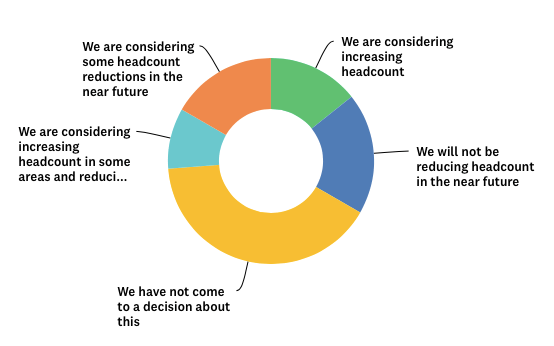
Some sectors have clearly seen little business impact and are looking to increase headcount. Just 17% feel they will definitely be losing employees in the near future. The majority appear not to have made up their minds – the nature and timing of the recovery will influence such planning. Potentially of most interest are the 10% of organisations who are likely to be either moving people around their business or losing headcount in some areas and increasing it in others.
(And this latter point is consistent with a parallel question asked around internal mobility – 64% of our respondents felt that their organisation would change, to the extent that moving people from role to role was a necessity. Everything is likely to be in flux – people returning, the workplace they return to and often the nature and offering of their employer).
The relative lack of enthusiasm around significant headcount losses is interesting. Are people being circumspect about this because we are all in unchartered territory? Or because there is a genuine desire to look after their people at such times? Or that they have experienced a hugely tight jobs market for several years and are reluctant to let talent go? Or that the government’s furloughing has simply kicked the problem down the road for another few months?
There was a similar response to a question around organisations’ likely intentions around their investment in Employer Brand.
Regarding our Employer Brand investment, we intend to:
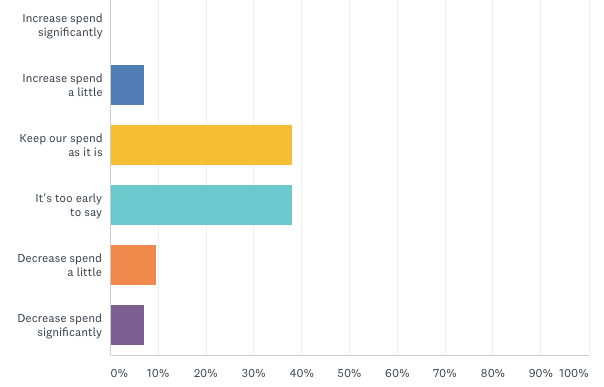
Little surprise that some 17% are intent on reducing spend at the very least by a little. However, with 38% either intending on keeping the same spending levels or feeling that it’s too early to make such a call, then the feeling of uncertainty is hard to ignore.
“My personal view is that at a time of such great uncertainty, employees and candidates alike need to feel safe and secure, which means they are likely to be more responsive to employer branding that emphasises these elements of an organisation. Therefore, there is an argument to say that resources and spend should increase – it certainly shouldn’t be ‘business as usual’ when it comes to employer branding activity over the coming months”. Mike Heal, MD and WDAD.
“I think even more so now than ever before, there’s going to be a spotlight on the authenticity of your employer brand and its relationship to your employee experience. How such authenticity, founded on trust and reputation, forms those relationships. And then how you build advocacy and loyalty throughout your recruitment processes”.
Craig Morgans.
What feels distinctly less promising were answers to a similar question around taking on early career people – apprentices, interns and graduates. 31% of our survey felt they would be reducing the number of such people they hire. And this is consistent with figures coming out of the Institute of Student Employers. By any measure, this does not feel like a great time to be leaving secondary or higher education – and, clearly, travelling is not the option it has been during other recessions.
If we move on to those people already within employment, what is their mindset around potentially changing jobs in the near future? Do they perceive themselves as candidates or simply people who are lucky to have jobs right now? Are they far more likely to keep their heads down than wonder what other career options are out there? One for additional research possibly, however, our survey felt strongly that persuading an individual currently in a role to leave and join another organisation was going to be a challenge given levels of caution and reticence.
“Great talent will always be in demand and for the foreseeable future, for various reasons i.e. loyalty, I think it’s going to be a lot harder to persuade these candidates to leave their current employer”.
Julian Ward.
To what extent to do you agree with the following statement? – I think it will be harder to persuade great talent to leave their jobs in the medium term
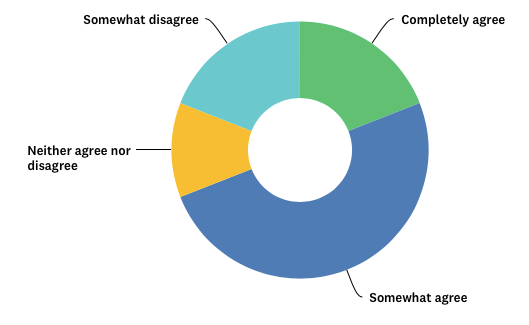
Very nearly 70% agreed with the statement and just 19% took the opposite view.
The talent acquisition community seems to feel that they will have to reach out to candidate audiences with real clarity around reassurance, trust and confidence. They feel that candidates probably won’t feel like candidates. There might also be a sense of gratitude and loyalty. If an individual has worked for an employer who has done the right thing through Covid-19, stuck with its people, communicated regularly and with empathy, it is likely to take much more to have them considering a career move away from such an employer.
Understanding candidate motivations in the aftermath of Covid-19 will be a fascinating challenge. What inspired us to change jobs and employers in January 2020 is unlikely to be the same as when September 2020 comes around.
“While in the short to medium term, it may be challenging to persuade great talent to leave their current role, many organisations are currently reviewing their working from home and flexible working practices. What this could mean is that where businesses have historically hired from a local or regional talent pool, there may be an opportunity to mine a much wider national or international talent pool, which could go some way to mitigating the challenge”.
Craig Morgans.
“Longer term, post Covid19, candidates may be looking for something completely different from a potential employer than they did moving into 2020. Employers hiring successfully will gain insight and take the time to understand clear shifts in mindset. Business models, markets and recruiting teams will then need to be able to pivot quickly and adapt”.
Julian Ward.
This leads on logically to an organisation’s EVP. Given that the entire employment landscape has been shifted like never before, within the space of just three months, does an organisation’s pre-Covid-19 EVP still feel valid in a much-changed world?
Reflecting on your Employee Value Proposition
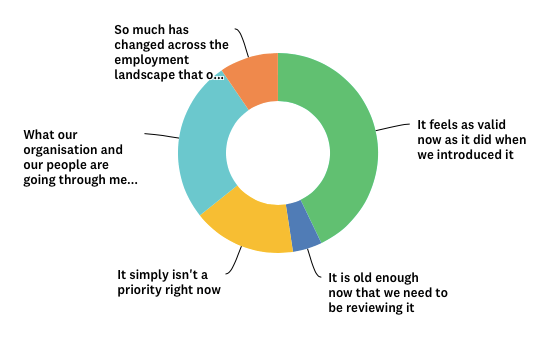
Understandably, there was a real range of answers. Pleasingly, for 43% of our survey, their EVP remained as valid now as when it was developed, suggesting that the process and outcomes of its creation were robust. For others this isn’t the right time to be talking about such an undertaking. I’m clearly not without a certain bias here, but delivering a Covid-influenced message or platform (or indeed EVP) to internal audiences, at the very least, feels of real importance to employee communities seeking reassurance.
However, for 36% of the organisations we surveyed, either the employment landscape or their own organisation and people had gone through such change that a review of their EVP felt inevitable.
“Approaching EVP from the basis of a brand may not be uppermost in people’s minds right now, but a deep listening exercise could yield lots of actionable data to help guide the HR agenda over the coming months, when some of the planned projects might not seem as pertinent as they once did”.
Julie Griggs.
In a way, much of the research and outputs are close to hand. Organisations have, in many cases, been keeping close to their people, listening to their concerns and fears.
They have also been listening to their stories. What has got them through lockdown? What have they learned? What would they do differently? How has their employer had their back? 67% of employers were already starting to collate the stories their people were telling about getting through Covid-19 and another 14% were actively considering this.
We then asked a number of questions around ethics and organisational behaviour. And, as with a number of other areas, the answers felt hugely positive. Too positive? Only time will provide us with such an answer. (A later question asked for respondents’ views on the prospects for their employer over the next few months – 69% felt these would be positive. And just 10% took a more negative position).
In my view, an organisation’s Employer Brand will be inextricably linked to the amount of empathy and support they have shown to their people and other stakeholders. The question was put to participants as to how proud they are likely to feel in the future if asked about how their employer conducted itself during Covid-19. The answers were pretty straightforward.
To what extent do you agree with the following statement? If candidates, in the future, ask you about how your organisation conducted itself during Covid-19, I would be proud of our answer

We put a not dissimilar question to our respondents about a new employee experience as people return to work. Will a return to normality be enough? Or are both employees and employers looking for something more, something better? Again, the answer was not ambiguous.
To what extent do you agree with the following statement? – We want to provide a better experience for our people when we return not simply go back to normal

There is an awful lot of noise about what the new normal is or should be. Or whether the term itself is meaningless. Having asked both employee and employer audiences a similar question recently, it’s very clear that real attempts are going to be made to change the employee experience for the better. Many organisations will be doing so and many employees will be expecting it. Those organisations who feel that a new normal should resemble the old normal, may find a disappointed workforce. And perhaps persuading employees from those organisations to move jobs might not be the challenge we expect.
Key out-takes
- No one knows for sure about how long Covid-19 will last – there are so many more questions than answers. However, this doesn’t mean that leadership shouldn’t continue to talk and engage with employees – just the opposite. Now more than perhaps ever before. Not having an answer doesn’t mean there shouldn’t be dialogue. Nothing sounds so ominous as silence;
- Reaching out to employee communities feels very patchy. Whilst there is much to recommend doing so via individual line managers, this will vary in effectiveness and empathy. Such reaching out is also impossible to measure;
- In many organisations, furloughed employees feel out of sight and out of mind. They, more than anyone else, need to know that their organisation is still thinking about them;
- The working from home momentum is entirely understandable but, equally, ignores the significant number of people who want to return to the workplace. This is not binary;
- Organisations feel disinclined to think about future job losses – is this realistic or optimistic?
- Organisations will have an awful lot on their corporate plate, however, the hiring of talent will not go away. What has perhaps gone away are pre-Covid motivations and employee propositions. Reaching out to talent audiences with a message that appears non-cognisant of what has happened and what it has brought, feels tone deaf and unlikely to appeal;
- How well do we understand the mindset of employees or potential candidates who remain in demand, who remain attractive to the competition, but who may be very wary about job changing right now?
 Getting to the heart of your employee mindset